Tuesday, May 26, 2009

Tuesday, May 19, 2009
Wednesday, May 6, 2009
Visualizing Music and Looking for Patterns
Found this and many other impressive videos on one Stephen Malinowski's YouTube channel. I really like the way the colored bar visualization separates out the different voices in a piece, especially the fugues.
The opening to Gödel, Escher, Bach has a fun discussion on the structure of the fugue-- the gist of it is that the composer develops the piece out of one short theme (a few measures of some simple melody), carried by a fixed number of voices. Starting with one voice expressing the theme, each additional voice chimes in repeating the theme until all are present. The theme is further explored and varied throughout the piece via transformations of the original melody: inverting, reversing, transposing, compressing. Soooo the video above is really cool, because the visualizations make it that much easier to pick out all the transformations that are taking place. Yay!
I wonder if you could make other visualization methods which help you pick out recurring themes in a piece, and are robust to transformations from the original theme (or measure distance from the original). It seems like a problem that crops up a lot, in problems from network analysis to predicting structural motifs in proteins. For instance, all integral membrane proteins will have a hydrophobic region which crosses the lipid bilayer-- this requires an extended sequence of hydrophobic amino acids, which will be reflected in the genetic code. There would be variation in sequence (not all membrane proteins would have the same arrangement of hydrophobic amino acids), but there might still be trends which might be picked up. Fourier/Laplace transforms can break a signal down into its periodic components; is there some way to transform a signal to visualize it in the space of its recurrent themes and their variations?
Saturday, April 25, 2009
Machine with Wishbone
"Caught in a symbiotic relationship, both the wishbone and the machine are unable to manifest fully without the other. We drag our pasts with us and move according to unseen forces. More and more, we interface with the world through our mental and technological creations."
View more of Arthur Ganson's kinetic sculptures on his YouTube channel.
Thursday, April 23, 2009
Kurzweil Reading Machine
Huh, I never knew this: according to a profile of Ray Kurzweil in Wired, the LexisNexis database-- now an enormous resource with extensive corporate, legal, and academic use-- grew out of a late 70's venture using Kurzweil's recently-developed character-recognition algorithms to scan legal documents and news articles.
Said character-recognition algorithms are a part of a text-to-speech tool Kurzweil continues to refine; its current incarnation is a software package for Nokia phones which will read aloud to you when held above a page.
Said character-recognition algorithms are a part of a text-to-speech tool Kurzweil continues to refine; its current incarnation is a software package for Nokia phones which will read aloud to you when held above a page.
Tuesday, April 21, 2009
The Wason Selection Task
The Wason Selection Task, a fun little test of logical reasoning commonly used in experimental psychology.
Sunday, April 19, 2009
The Amen Break
Okay okay, I couldn't resist grabbing this as well-- again via the Worldwide Cultural Gonzo Squad, an oddly captivating video on the Amen Break, a six-second-long drum loop from the b-side of a 1969 single which was taken up by early sample-based music and is now the basis for entire musical subgenres, as well as every advertisement soundtrack ever. Also interesting for its discussion of copyright law, and the fact that it's narrated by a surprisingly realistic electronic voice.
Saturday, April 18, 2009
Sound to Pixels
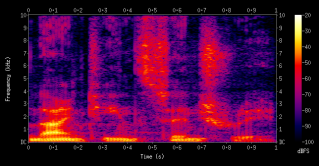
Found a nifty article about a piece of digital music software called Photosounder, posted on a blog called Create Digital Music. Photosounder is an image-sound editing program-- that is, music creation is done visually, by drawing and editing the sound's spectrogram. The videos in the CDM article show some of the ways in which this software is being used; it's pretty impressive stuff. I also found this plugin for winamp which produces a simple spectrogram of your music as a visualization, if you're just curious to see what the music you're listening to would look like.
The spectrogram is actually a good representation of how sound is coded in the brain-- the cochlea in your ear breaks down sound input into narrow frequency bands, just as we see on the X axis of the spectrogram, and cells in each frequency band fire in proportion with the intensity of sound at that frequency (so, you have a physical structure in your ear which performs a Fourier transform-- how cool is that?) As seen in this video, a single sound object usually consists of several harmonics, and a full spectrogram can be quite complex-- and yet our brain can easily segment that spectrogram to identify different instruments, even when there's a lot of frequency overlap. We are even able to focus our attention on one specific instrument, which means selectively responding to one particular batch of signals as they move up and down across frequency channels/cell populations. Brains are pretty awesome, guys.
(And on another note: as you can see in the aforelinked video, one of the easiest ways to pick out one instrument from a spectrogram is to look for elements which "move together" in time/across the spectrum-- this notion drives a lot of work in both auditory processing and the corresponding problem of object recognition in computer vision.)
Wednesday, April 15, 2009
Mayang's Free Texture Library
Mayang's Free Texture Library is a great source of high-res textures and some object stock. A lot of the images in the man-made, metal, and nature sections make nice texture overlays to add some depth and, um, texture to digital artwork.
See this page for one method for applying these images as texture overlays in photoshop.
See this page for one method for applying these images as texture overlays in photoshop.
Tuesday, April 14, 2009
Please Say Something
Please Say Something - Full Length from David OReilly on Vimeo.
A troubled relationship between a Cat and Mouse set in the distant Future. Winner of the Golden Bear for best short film at the 2009 Berlinale. (Click the link for full view.) His other stuff is pretty cool too, like When You're Smiling and the video he did for Venetian Snares.
Subscribe to:
Posts (Atom)

